


[ad_1]
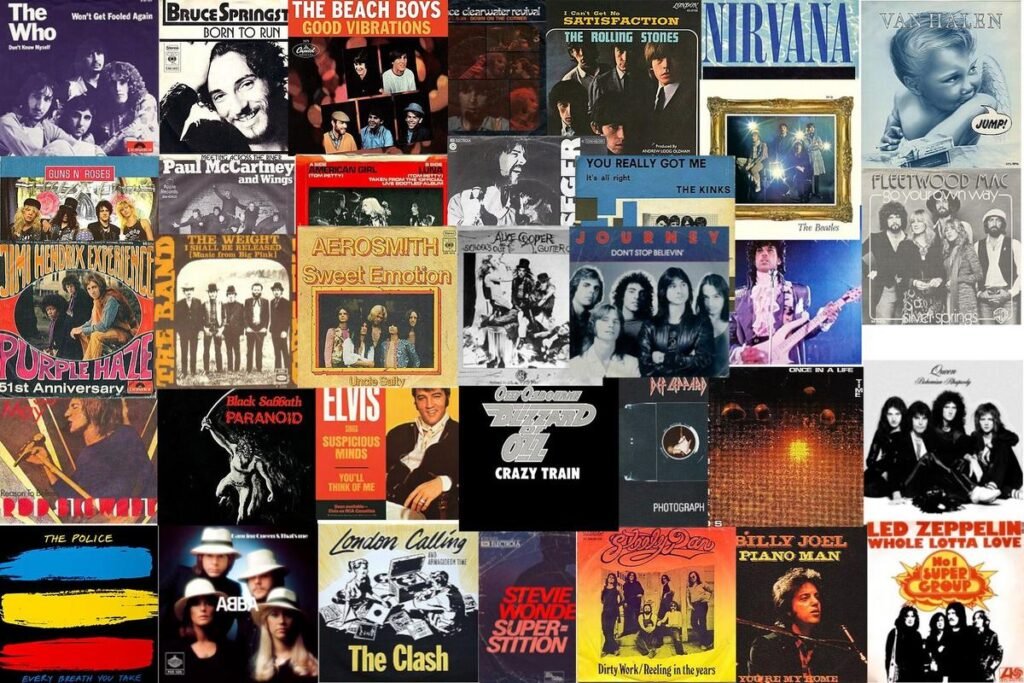
The list of the Top 100 Rock Songs isn’t limited to traditional rock ‘n’ roll records. Pop, soul, disco and metal also find a place.
But as the list below, selected by the UCR staff, shows, they all fall under the broad umbrella of rock music (though, on closer reflection, maybe «popular music» would be a more accurate summation).
In any case, these 100 songs tell the story of music — rock, popular or whatever you want to call it — of the past several decades. It’s a history less with a beat, a cultural narrative told in 4/4 time. These are the songs that shaped generations.
100. Jackson Browne, «Running on Empty» (From Running on Empty, 1977)
Jackson Browne‘s tribute to touring leads the same-named album, a reflection of life on the road featuring new songs recorded onstage, backstage, on tour buses and in hotel rooms. «Running on Empty» is both a slightly weary account of the life of a touring artist and the payoff it ultimately yields: «If I can get you to smile before I leave,» he sings.
99. The Allman Brothers Band, «Ramblin’ Man» (From Brothers and Sisters, 1973)
Two years after guitarist Duane Allman‘s death, the Allman Brothers Band made their first full album without him (1972’s Eat a Peach was a part-live record featuring studio cuts Allman had worked on). Brothers and Sisters is a triumph of their spirit, with the surviving members sounding renewed, especially in Dickey Betts‘ hit «Ramblin’ Man.»
98. Aerosmith, «Walk This Way» (From Toys in the Attic, 1975)
Aerosmith was coming off two moderate-selling albums when their third, Toys in the Attic, brought them close to the Top 10 for the first time. Much of that success was due to the riff-piling second single «Walk This Way.» A decade later, a Run-D.M.C. remake (featuring Joe Perry and Steven Tyler) helped spur the Boston group’s comeback.
97. Funkadelic, «One Nation Under a Groove» (From One Nation Under a Groove, 1978)
The lines were blurred to the point of no distinction between Funkadelic and Parliament as the 1970s ended. Where once it was easy to divide George Clinton‘s P-Funk enterprise — the rock side and the soul side — in 1978, there was no clear separation. Funkadelic’s «One Nation Under a Groove» is a collective highlight, no matter the name.
96. Sex Pistols, «Anarchy in the U.K.» (From Never Mind the Bollocks, Here’s the Sex Pistols, 1977)
Punk’s starting point (the single actually came out during the final weeks of 1976) still sounds like a revolutionary dividing of lines. After «Anarchy in the U.K.,» new bands with new outlooks stormed both the charts and venues. Sex Pistols famously imploded within a year of their debut LP, but their first single earns its place as a pivotal moment.
READ MORE: Punk Rock’s 40 Best Albums
95. Elvis Presley, «Heartbreak Hotel» (From 1956 single)
Elvis Presley‘s debut RCA single still sounds like an announcement of changing tides. Or maybe it’s a warning. Following a string of influential but low-selling singles for tiny Sun Records, the 21-year-old Presley took «Heartbreak Hotel» to No. 1 and in effect hurled rock ‘n’ roll into the mainstream. A significant moment of the 20th century.
94. The Byrds, «Eight Miles High» (From Fifth Dimension, 1966)
By 1966, the Byrds were beginning to shed their folk-rock label and move into more adventurous territory. «Eight Miles High,» inspired by a plane trip to London and, more importantly, the music of John Coltrane and Ravi Shankar, started the group’s new journey into psychedelia. A milestone in rock music’s evolution; their growth continued.
93. Ray Charles, «What’d I Say» (From What’d I Say, 1959)
When Ray Charles brought R&B to the church in the mid-1950s, he caused controversy among the faithful. When he released «What’d I Say» in 1959, he didn’t even bother to disguise the explicit sexual energy. Divided into two parts, the song reserved its back half for a sweat-drenched call-and-response between Charles and his backing singers.
92. Fleetwood Mac, «Dreams» (From Rumours, 1977)
Fleetwood Mac‘s three main songwriters used Rumours as a means of airing their respective grievances (and occasional rare joy) with their romantic partners; as Lindsey Buckingham and Stevie Nicks‘ relationship was coming to an end, their songs detailed the bloody aftermath. «Dreams,» Nicks’ side of the story, gave the group its only No. 1.
91. Crosby, Stills, Nash & Young, «Ohio» (From 1970 single)
Crosby, Stills, Nash & Young‘s «Ohio» was released just a month after the incident that it’s about — the killing of four students by the Ohio National Guard at Kent State University in May 1970 — occurred. Neil Young gathered his bandmates, whose debut album as a quartet came out in March, for a session to record his timely protest song.
90. David Bowie, «Heroes» (From «Heroes,» 1977)
As with the first LP in David Bowie‘s Berlin Trilogy, the second, «Heroes,» is divided between ambient-sculpted electronic experiments and more traditional pop and rock songs. The title track is the album’s breathtaking centerpiece, a slow-building summit of the past and future. It’s one of Bowie’s greatest and emotionally stirring performances.
89. The Police, «Every Breath You Take» (From Synchronicity, 1983)
Sting never intended for his demented love song to take on the stature it did in 1983. As the lead single of the Police‘s fifth and final album, Synchronicity, «Every Breath You Take» was an immediate hit and a worldwide No. 1. Widely misinterpreted as an attentive valentine, the song’s real, darker meaning becomes apparent with a listen.
READ MORE: Top 30 Albums of 1975
88. Pink Floyd, «Wish You Were Here» (From Wish You Were Here, 1975)
After 1973’s The Dark Side of the Moon propelled Pink Floyd to unfathomable new heights, the group set to work on its ninth album, a semi-tribute to cofounder Syd Barrett, whose personal issues led to his departure in 1968. Wish You Were Here is filled with intimate reflections, none more moving than the poignant title track.
87. Percy Sledge, «When a Man Loves a Woman» (From When a Man Loves a Woman, 1966)
The tangled history of «When a Man Loves a Woman» adds to its allure. Alabama-born singer Percy Sledge initially recorded the song at Muscle Shoals’ FAME Studios, but the session was moved to nearby Norala. The out-of-tune horns, which were rerecorded but then erroneously left off, give the No. 1 Southern soul classic its haunting aura.
86. Grateful Dead, «Dark Star» (From 1968 single)
Grateful Dead‘s 1968 single, less than three minutes of psychedelia-soaked feedback and art-rock, is a mere launching point for where the song would head onstage throughout the band’s career. They would often stretch the work to the half-hour point live, occasionally topping out at 50 minutes. Rock ‘n’ roll exploration at its headiest.
85. Fleetwood Mac, «Go Your Own Way» (From Rumours, 1977)
Lindsey Buckingham and Stevie Nicks helped steer Fleetwood Mac into a platinum-selling band with the 1975 self-titled LP; with Rumours, they became one of the biggest groups in the world. The bitter kiss-off «Go Your Own Way» was released as the album’s first single and confirmed that Fleetwood Mac wasn’t a fluke. Much turmoil followed.
84. Judas Priest, «You’ve Got Another Thing Comin'» (From Screaming for Vengeance, 1982)
Judas Priest‘s breakthrough song received a huge boost in 1982 thanks to MTV’s growing influence, which gave acts with active but smaller fan bases much-needed commercial exposure. It helped that «You’ve Got Another Thing Comin'» came with a melodic hook and singer Rob Halford‘s effortless way of easing into a song’s groove.
83. Iron Maiden, «The Number of the Beast» (From The Number of the Beast, 1982)
Following a viewing of Damien: Omen II, Iron Maiden bassist Steve Harris had a nightmare about the demonic child and immediately wrote the Revelation-quoting «The Number of the Beast.» The title track to the band’s first LP with singer Bruce Dickinson became an instant favorite among fans and has remained in their set lists ever since.
82. Blue Öyster Cult, «(Don’t Fear) The Reaper» (From Agents of Fortune, 1976)
It’s now a punch line to a Saturday Night Live joke because of its cowbell. But Blue Öyster Cult‘s «(Don’t Fear) The Reaper» originated from a very serious and uncertain place, when singer and guitarist Donald «Buck Dharma» Roeser started contemplating an early death. It was the New York band’s biggest hit, stopping just short of the Top 10.
81. Buffalo Springfield, «For What It’s Worth» (From 1966 single)
Despite popular opinion, Buffalo Springfield‘s «For What It’s Worth» isn’t about the still-escalating Vietnam War but a 1966 riot on the Sunset Strip triggered by a curfew imposed on Los Angeles teens. Stephen Stills‘ cautious «Stop, hey, what’s that sound?» refrain leaves the song open to interpretation and, in turn, an uneasy timelessness.
80. John Lennon, «Instant Karma! (We All Shine On)» (From 1970 single)
All of the Beatles were ready to move on with their solo careers by 1970, none more so than John Lennon, who made three experimental noise and found-sound albums with Yoko Ono before the group split. 1970’s quickly recorded and released «Instant Karma! (We All Shine On)» marked the return to his rock ‘n’ roll roots and to the charts.
79. Def Leppard, «Bringin’ On the Heartbreak» (From High ‘n’ Dry, 1981)
First released on Def Leppard‘s second album, 1981’s High ‘n’ Dry, «Bringin’ On the Heartbreak» hinted at the band’s commercial breakthrough two years later. The power ballad was resurrected and remixed after Pyromania‘s huge success, and used as a stopgap single in 1984 as the band plotted its next move. This time it was a minor hit.
78. Bon Jovi, «Livin’ on a Prayer» (From Slippery When Wet, 1986)
Bon Jovi was still figuring out their place in the mid-’80s pop-metal landscape when they latched on to the middle ground between MTV’s current fashions and arena-sized aspirations. The result was Slippery When Wet, an era-defined set of songs stuck between New Jersey and Los Angeles. «Livin’ on a Prayer» is the multihook axis.
77. Van Halen, «Jump» (From 1984, 1984)
Van Halen‘s 1984 makeover began with this single, released weeks before the album arrived early in the year. «Jump» pulsates with new energy, as synths and a sense of playfulness, melodic and otherwise, dominate the No. 1 song. Within a year, singer David Lee Roth was gone, and the group continued to move forward in its new outpost.
76. Elvis Presley, «Hound Dog» (From 1956 single)
Jerry Leiber and Mike Stoller wrote «Hound Dog» for rhythm and blues singer Big Mama Thornton in 1952; four years later, Elvis Presley had his third No. 1 in six months with his rocked-up version. It became a defining moment in his discography, paired as a double-sided hit with «Don’t Be Cruel» and setting in motion a frantic two years.
75. Don Henley, «The Boys of Summer» (From Building the Perfect Beast, 1984)
The breakup of the Eagles in 1980 led its members down various paths in the years that followed. More so than any of his former bandmates, Don Henley went down the socially conscious trail, turning reflective and nostalgic in his solo work. 1985’s «The Boys of Summer» brings summer romance as a rumination on vanished idealism.
74. Chuck Berry, «Johnny B. Goode» (From 1958 single)
A rock ‘n’ roll pillar and ground zero for thousands of guitar riffs over the decades, «Johnny B. Goode» is more than a bit of self-mythologizing from one of the genre’s architects; it’s an anthem for the ages. Chuck Berry had played variations on the song’s famous opening lick before; here, it turns into a signature moment and a ’50s beacon.
73. Sly & the Family Stone, «Family Affair» (From There’s a Riot Goin’ On, 1971)
Fame, drugs and more had begun to pull Sly Stone away from his music and group at the start of the ’70s, forcing the enigmatic singer and songwriter into seclusion, where he assembled much of Sly & the Family Stone‘s fifth album by himself. The murky «Family Affair» is noteworthy as one of the first popular songs to use a drum machine.
72. Iron Maiden, «Run to the Hills» (From The Number of the Beast, 1982)
Bruce Dickinson’s replacement of Paul Di’Anno as Iron Maiden’s singer had a significant effect on the band, both creatively and commercially. His first album with the metal giants, The Number of the Beast, was the group’s first No. 1 in the U.K., and its lead single, «Run to the Hills,» was their first Top 10. A pivotal moment for band and genre.
71. Prince and the Revolution, «Kiss» (From Parade, 1986)
After Purple Rain made Prince one of the world’s biggest stars, he was positioned to call the shots on his next projects. First up was the paisley-colored Around the World in a Day; after that was the more familiar-sounding Parade, a sort of film and soundtrack sequel to Purple Rain. «Kiss,» its funk-powered lead single, is the LP’s highlight.
70. The Jimi Hendrix Experience, «Purple Haze» (From 1967 single)
Not the Jimi Hendrix Experience‘s debut single, but a proper introduction to the trio’s soon-to-revolutionary style of psychedelic blues and rock. Penned by Hendrix and filled with surreal, Summer of Love imagery, «Purple Haze» became a signature song in the London-via-Seattle guitarist’s expanding repertoire — peak mind-expanding pop music.
69. The Who, «My Generation» (From My Generation, 1965)
The Who‘s proto-punk youth anthem has served as a rebellious declaration of intent for decades now. Pete Townshend designed «My Generation» as such — «I hope I die before I get old» — while keeping his eye on the bigger picture. It’s one of the 1960s’ rock cornerstones, all slashing guitars, stuttered vocals and fist-punching intensity.
68. Bob Dylan, «Tangled Up in Blue» (From Blood on the Tracks, 1975)
A 1974 tour with the Band got Bob Dylan back on track, but it’s the album released a year later that secured his ’70s comeback. Blood on the Tracks surveyed the broken pieces of Dylan’s gasping marriage, its songs alternating between viciously cruel and exhausted resignation. The winding «Tangled Up in Blue» falls somewhere in between.
67. Don McLean, «American Pie» (From American Pie, 1971)
Singer-songwriter Don McLean surveys the cultural history of the late ’50s and ’60s over nearly nine minutes, referencing Buddy Holly, Bob Dylan, the Beatles and the Rolling Stones in «American Pie»‘s sprawling narrative. «The day the music died» is the launching point; by the end, a decade of turmoil has turned into a gang sing-along.
66. Prince and the Revolution, «Purple Rain» (From Purple Rain, 1984)
Prince was on the verge of something big in 1984 when he released the soundtrack to his film Purple Rain. For the next 12 months, he was one of the biggest and busiest artists in the world, writing, recording, producing and touring. «Purple Rain» is the LP’s epic closing song, designed as a showstopper. Few songs in his catalog hit this hard.
65. Four Tops, «Reach Out I’ll Be There» (From Reach Out, 1967)
Everyone at the Motown label, from executives to the performers, was becoming more ambitious as the 1960s progressed. With «Reach Out I’ll Be There,» the Four Tops entered a phase of musically adventurous singles that both stirred their pop and R&B foundations and challenged the sonic walls constructed by the label’s architects.
64. Queen, «Bohemian Rhapsody» (From A Night at the Opera, 1975)
One of the most ambitious singles ever released, Queen‘s «Bohemian Rhapsody» takes left turns into several unexpected areas before landing somewhere between pop opera and musical theater. The song has had an unexpected shelf life, too, becoming a hit upon its release in 1975 and then again in 1992 after appearing in Wayne’s World.
63. Carl Perkins, «Blue Suede Shoes» (From Dance Album of Carl Perkins, 1958)
Written and recorded in 1955 by Carl Perkins as a rockabilly-country number for Sun Records, less than a month after Sam Phillips sold Elvis Presley’s contract to RCA, «Blue Suede Shoes» became one of the Memphis label’s first crossover hits on the pop, R&B and country charts. Presley soon covered it, leading his debut LP with the song.
62. The Ronettes, «Be My Baby» (From Presenting the Fabulous Ronettes, 1964)
Phil Spector was coming off several hit singles with the Crystals when his interest shifted to the Ronettes, a New York City girl group that had released a handful of songs for Colpix Records. «Be My Baby,» their stakes-claiming debut on Spector’s Philles label, became a No. 2 hit and remains the greatest girl-group single ever made.
61. The Jimi Hendrix Experience, «All Along the Watchtower» (From Electric Ladyland, 1968)
The Jimi Hendrix Experience’s reworked take on Bob Dylan’s «All Along the Watchtower» not only refigured the folksy original, released less than a year before, but also cast it into a new electric light that surpasses the source. Dylan was so impressed with Hendrix’s cover that he began performing the song in a similar style in the ’70s.
60. Steely Dan, «Reelin’ in the Years» (From Can’t Buy a Thrill, 1972)
They’d get more derisive and acerbic as the ’70s rolled on, but Steely Dan was rarely as loose and straightforward as they are on their second single. «Reelin’ in the Years,» unlike many of the band’s best songs, reaches a high point early («Dumb but effective,» Donald Fagen said). Jimmy Page called Elliott Randall’s guitar solo his all-time favorite.
59. Paul McCartney and Wings, «Band on the Run» (From Band on the Run, 1973)
By 1973, Paul McCartney had found his groove with Wings. After a few years left stunned by the Beatles’ breakup, leading to a solo record and a collaboration LP with his wife Linda, McCartney’s new group completed his best set of songs since the ’60s with 1973’s Band on the Run. The three-part title tune flashes with Beatles-like initiative.
58. Lynyrd Skynyrd, «Free Bird» (From [Pronounced ‘Lĕh-‘nérd ‘Skin-‘nérd], 1973)
One of rock’s great concert songs gains its power from a two-part structure. Lynyrd Skynyrd‘s «Free Bird» starts as a semi-acoustic ballad, partly written in tribute to Duane Allman, before guitar solos from Allen Collins and Gary Rossington bring it to a resounding end. The studio version fades at nine minutes; live, the song runs over 15.
57. James Brown, «Get Up (I Feel Like Being a) Sex Machine» (From 1970 single)
One of the first songs James Brown recorded with his new group, which included bassist Bootsy Collins and drummer Jabo Starks, «Get Up (I Feel Like Being a) Sex Machine» introduced a new dimension to the Godfather’s already-lauded arsenal of licks and riffs. 1970s funk begins here. Go for the 11-minute LP version for maximum results.
56. Black Sabbath, «War Pigs» (From Paranoid, 1970)
«War Pigs» sounds like the apocalypse has already arrived, and no protest song is going to keep it from developing. But Ozzy Osbourne and Black Sabbath do their best to prevent it in Paranoid‘s album opener. Over eight, increasingly harsh minutes, the track fluctuates its pace, racing and slowing down to make its points. A heavy metal pioneer.
55. Led Zeppelin, «Kashmir» (From Physical Graffiti, 1975)
«Kashmir» sounds like a gargantuan beast lurching from the other side of the mountain, each step beckoning the approaching doom. The Physical Graffiti track gains much of its force from the exotic hum throughout; Led Zeppelin, at the height of their collective playing, have never sounded as compelling or more determined than they do here.
54. Bruce Springsteen, «Thunder Road» (From Born to Run, 1975)
«Thunder Road» was more than a coming-out moment for Bruce Springsteen; the Born to Run opener also served as the inviting screen door to a world of characters that existed somewhere between the New Jersey streets and Springsteen’s fertile mind. Roy Orbison, talking guitars and faith in the magical power of night are all part of the story.
53. Oasis, «Wonderwall» (From [What’s the Story] Morning Glory?, 1995)
Its title was taken from a George Harrison soundtrack album, and much musical inspiration was borrowed from the Beatles (especially the use of the mellotron’s orchestral settings), but «Wonderwall» remains Oasis‘ definitive track. This era-spanning love song has been covered hundreds of times, proving as timeless as its influences.
52. Journey, «Don’t Stop Believin'» (From Escape, 1981)
Journey achieved immortality with their 1981 song «Don’t Stop Believin’,» the highlight of their best album, Escape. Having shed their jazz-fusion roots throughout the ’70s, the group entered another phase by the ’80s, with singer Steve Perry and keyboardist Jonathan Cain bringing a hitherto inconceivable pop shrewdness to their music.
51. Billy Joel, «Piano Man» (From Piano Man, 1973)
Billy Joel‘s signature song came from a very real place in his life in the early ’70s, when his career seemed to have bottomed out, and he was forced to play piano in lounges to get by. «Piano Man» gave him his first Top 40 hit and a renewed spark to resume recording. Within three years, he was in the Top 10 and a multiple Grammy winner.
50. ZZ Top, «Sharp Dressed Man» (From Eliminator, 1983)
ZZ Top was ready for a change by the time MTV started its cultural climb in the early ’80s. The Texas trio had already started experimenting with synthesizers and modern takes on their boogie blues when they released Eliminator in 1983. The album was an immediate hit and revived the band; «Sharp Dressed Man» helped set their new image.
49. Rush, «The Spirit of Radio» (From Permanent Waves, 1980)
Rush tested commercial waters with their seventh album, 1980’s Permanent Waves, by adding tighter songwriting and a more radio-friendly sound to their hard-progressive mix. No song more embraced this new openness than «The Spirit of Radio,» a melodic tribute to broadcast airwaves that, no coincidence here, became their FM breakthrough.
READ MORE: 25 Under-the-Radar Albums From 1976
48. Procol Harum, «A Whiter Shade of Pale» (From 1967 single)
A song partly based on Chaucer, featuring a baroque organ heavily influenced by Bach? It was a different time in 1967, when Procol Harum released their debut single, which was cherished and envied by John Lennon, Paul McCartney and Brian Wilson. The lovely «A Whiter Shade of Pale» still sounds unlike anything from its period or any other.
47. Talking Heads, «Once in a Lifetime» (From Remain in Light, 1980)
The worldly rhythms and Brian Eno collaborations reached their apex on Talking Heads‘ fourth album, an overflow of ideas and sounds that Remain in Light can barely keep up with at times. The gurgling «Once in a Lifetime» became a surprise hit when MTV began showing its peculiar video («Same as it ever was!«), making David Byrne an early star.
46. Metallica, «Master of Puppets» (From Master of Puppets, 1986)
Metallica‘s metal totem has lost none of its impact since its 1986 release. Master of Puppets remains a metal cornerstone; the eight-and-a-half-minute title track — an anti-drug thrasher — holds the thread that runs throughout the album. The band has rarely performed a live set without «Master of Puppets,» a testament to its longstanding legacy.
45. The Supremes, «Where Did Our Love Go» (From Where Did Our Love Go, 1964)
The Supremes‘ first No. 1 is one of Motown’s crown jewels. Written by Holland-Dozier-Holland and backed by the Funk Brothers, «Where Did Our Love Go» arrived at the beginning of the label’s golden period. More hit songs, many by the singing trio, would come, but this remains a special part of the history. Peak everything is on display.
44. Simon & Garfunkel, «Bridge Over Troubled Water» (From Bridge Over Troubled Water, 1970)
«Bridge Over Troubled Water» sounds like a requiem for the duo of Paul Simon and Art Garfunkel, with its elegiac pacing and hymn-like tone. The pair would separate shortly after the release of their fifth album, also titled Bridge Over Troubled Water. With their biggest, most elegant song, Simon & Garfunkel crafted a timeless new standard.
43. The Kinks, «You Really Got Me» (From Kinks, 1964)
It’s not just the fuzzed-out sound of Dave Davies‘ guitar during his solo (achieved after he sliced his amp with a razor) that lifts the Kinks‘ «You Really Got Me» into another field; it’s the garage-meets-punk energy of the song that makes it a pivotal song of the ’60s and later. Entire genres were spawned in less than two and a half minutes.
42. Kiss, «Detroit Rock City» (From Destroyer, 1976)
With their fourth album, 1976’s Destroyer, Kiss took advantage of Alive!‘s success a year earlier, working with Alice Cooper and Lou Reed producer Bob Ezrin for their most polished and accomplished studio LP. Its opening song, «Detroit Rock City,» is a tribute to fans, including one who died in a car accident on his way to a Kiss show.
41. Led Zeppelin, «Whole Lotta Love» (From Led Zeppelin II, 1969)
The many and distinct sections of «Whole Lotta Love» encapsulate the pace at which Led Zeppelin was moving in 1969. Blues quotes, room-shaking guitar, mid-song psychedelic freakout, proto-metal heaviness, and several starts and stops figure into the track’s five and a half minute run time. After this, the band was unstoppable.
40. Aerosmith, «Dream On» (From Aerosmith, 1973)
While «Dream On» wasn’t a hit the first time around for Aerosmith, the big «Stairway to Heaven»-like ballad from their self-titled debut was a pivotal moment in their evolution. By 1975, two years after its initial release, the song was rereleased following the success of «Walk This Way.» This time, it gave the Boston band its first Top 10 single.
39. The Who, «Baba O’Riley» (From Who’s Next, 1971)
The opening song on Who’s Next must have felt like a release and relief after their ambitious follow-up to Tommy, the long-shelved Lifehouse, finally came out truncated and renamed. Loops, synths and a sense of forward motion shape «Baba O’Riley,» the opening song on the Who’s classic fifth LP. They were never bigger or better.
38. The Who, «Won’t Get Fooled Again» (From Who’s Next, 1971)
The Who’s bookend to «Baba O’Riley» is every bit as monumental as Who’s Next‘s opener. Slotted as the album’s critical closing track, «Won’t Get Fooled Again» builds over eight increasingly dramatic minutes, leading to Roger Daltrey‘s climactic, wall-scaling scream. The track is part victory lap and part defense by a band at its peak.
37. Van Halen, «Runnin’ With the Devil» (From Van Halen, 1978)
The opening song on Van Halen’s self-titled debut album signaled a changing of the guard as the ’70s drew to a close. From Eddie Van Halen‘s power-drill guitar that opens the song to arena-sized rhythmic heft throughout, «Runnin’ With the Devil» sounds like a menacing storm gathering on the horizon. A new hard rock paradigm was set here.
36. The Jackson 5, «I Want You Back» (From Diana Ross Presents the Jackson 5, 1969)
Michael Jackson was only 11 when he recorded his star-making vocal for the Jackson 5’s «I Want You Back.» The song was considered for a few other Motown artists (including Gladys Knight & the Pips and Diana Ross) before it was given to their new family group as their debut single. It quickly shot to No. 1 on the pop and soul charts.
35. Smokey Robinson and the Miracles, «The Tracks of My Tears» (From Going to a Go-Go, 1965)
Motown’s greatest year included «Stop! In the Name of Love,» «I Can’t Help Myself» and «Uptight (Everything’s Alright).» But its greatest achievement in 1965 was Smokey Robinson and the Miracles’ «The Tracks of My Tears,» one of the most perfect examples of record-making in the 20th century, with Robinson’s greatest-ever vocal performance.
34. Ozzy Osbourne, «Crazy Train» (From Blizzard of Ozz, 1980)
Ozzy Osbourne was pretty much written off at the end of the ’70s, his career severed after being fired from Black Sabbath, and his personal life a combustible cocktail of drugs and booze. Then, as the new decade dawned, he got a new band, a new record deal and a renewed lease on life. The hurtling «Crazy Train» proved he was back.
33. Alice Cooper, «School’s Out» (From School’s Out, 1972)
A celebration of summer in any form is always welcome, but when tied to the end of the school year, as it is in Alice Cooper’s exhilarating «School’s Out,» it no doubt has even greater meaning for kids. No surprise then that the song became the band’s only Top 10 hit. Bonus points for Cooper’s inspired line, «We can’t even think of a word that rhymes.«
32. Nirvana, «Smells Like Teen Spirit» (From Nevermind, 1991)
The song that launched a ’90s revolution. Alternative rock, college rock, modern rock, indie rock — no matter what it’s called, it was stirring throughout the ’80s. But in 1991, Nirvana kicked down the door that closed off the music from mainstream success. «Smells Like Teen Spirit» is the nucleus of an entire generation of bands and albums.
31. Def Leppard, «Photograph» (From Pyromania, 1983)
The song that propelled Def Leppard into the mainstream and into a new era, not so coincidentally, also introduced a more polished version of the band’s metal-pop sound, with nods to ’70s glam. «Photograph» benefited from an outpouring of MTV airings, but the song’s chewy center and big hooks likely would have found an audience regardless.
30. Derek and the Dominos, «Layla» (From Layla and Other Assorted Love Songs, 1970)
Recovering from the breakups of Cream and Blind Faith, and then mired in drug and alcohol problems exacerbated by his love for his friend George Harrison’s wife, Eric Clapton sank his despair into a new project called Derek and the Dominos. Their only album produced «Layla,» an elegiac seven-minute heartfelt plea for his unrequited love.
29. The Band, «The Weight» (From Music From Big Pink, 1968)
Buzz surrounding the Band had reached a frenzied point before they even released a note of music. Gigs with Bob Dylan, on his 1966 tour and in the intimate recordings The Basement Tapes, helped build anticipation for their 1968 debut, Music From Big Pink. Robbie Robertson‘s «The Weight» is the LP’s timeless story of burdens passed along.
28. Bob Seger & the Silver Bullet Band, «Night Moves» (From Night Moves, 1976)
Bob Seger‘s nostalgic look back at his pubescent years arrived during a particularly productive time for the Detroit rocker, who began his professional career in 1961 with a single by his teenage band. A live album released earlier in 1976 became a radio favorite; the mid-tempo «Night Moves» gave him his first Top 10 hit and a new stage.
27. Rod Stewart, «Maggie May» (From Every Picture Tells a Story, 1971)
Rod Stewart and Faces were inseparable during the first couple of years of the ’70s, with the band often joining their singer on his solo records. His first No. 1, «Maggie May,» features Ian McLagan and Ronnie Wood, and was a regular number in their live performances in 1971 and 1972. The song’s ragtag appeal makes it timeless.
READ MORE: Rod Stewart Albums Ranked
26. Elvis Presley, «Suspicious Minds» (From 1969 single)
After Elvis Presley left the Army in March 1960, he spent the next several years recording mostly substandard songs and making increasingly unwatchable movies. Then, in 1968, he filmed a TV comeback special, soon followed by sessions in Memphis that revitalized his career. «Suspicious Minds» is the highlight of this excellent period.
25. Queen, «We Will Rock You» (From News of the World, 1977)
There isn’t much to «We Will Rock You»: a stomp-clap beat, a gang-shouted chorus and a guitar solo that forces itself into the frame. And it’s all over in two minutes. As the opening track on Queen’s sixth album, the song sounds like an introduction, which is precisely what it is — to both the LP and «We Are the Champions.» But it’s so effective.
24. Little Richard, «Tutti Frutti» (From Here’s Little Richard, 1957)
Like other songs from rock’s crucial early years, Little Richard‘s «Tutti Frutti» still seems like a key moment in music history. The nonsensical «Wop bop a loo bop a lop bom bom!» is as otherworldly sounding today as it was in 1955, and Richard’s off-the-rails delivery convinces with every whoop, holler and aside. No wonder parents were scared.
23. Black Sabbath, «Paranoid» (From Paranoid, 1970)
Nobody could ever accuse Black Sabbath of going pop, but for one fleeting moment in late 1970, the hard-rock and proto-metal giants got as close as they ever would to sounding like a Top 40 band. «Paranoid» reached No. 4 in the U.K. and No. 61 in the States, with its 2:48 run time and slippery melody almost tailor-made for the radio.
22. Eddie Cochran, «Summertime Blues» (From 1958 single)
Teen angst was nothing new to rock ‘n’ roll, but Eddie Cochran took it to a new level in «Summertime Blues.» Over three verses, he complains about his job, his parents and his politicians, while offering no form of compromise or solution: «I wouldn’t go to work, told the boss I was sick.» Blue Cheer and the Who later added more noisy racket.
21. Guns N’ Roses, «Welcome to the Jungle» (From Appetite for Destruction, 1987)
A fitting introduction to the game-changing hard rock band, «Welcome to the Jungle» was savage, intimidating and a little bit dangerous, everything most of Guns N’ Roses‘ late-’80s contemporaries weren’t. Appetite for Destruction issued a challenge; most MTV-blessed groups couldn’t meet it. The snaky «Jungle» rides an endless groove.
20. The Clash, «London Calling» (From London Calling, 1979)
«London Calling» was more than a signal of intent from the world’s greatest punk band in 1979; it announced a current of change. The same-titled double album wraps an entire history of popular music into its 65 minutes; the song leads a charge of punk-rock tenacity that barely touches on the Clash‘s breadth. A new future awaited them.
19. Roy Orbison, «Oh, Pretty Woman» (From 1964 single)
Inspired by Roy Orbison’s wife, who was also the woman praised in his «Claudette,» a minor hit in 1958 for the Everly Brothers, «Oh, Pretty Woman» became the Texas songwriter and singer’s second No. 1. The song’s famous guitar riff, close to rockabilly in its stabby execution, leads one of Orbison’s best and most identifiable tracks.
18. Aretha Franklin, «Respect» (From I Never Loved a Man the Way I Love You, 1967)
Otis Redding wrote and recorded «Respect» as a fussy demand put upon an indifferent romantic partner. In Aretha Franklin‘s hands, the song became something totally different. Initially a gender spin on Redding’s words, Franklin’s powerhouse 1967 hit has grown from its feminist roots into a powerful voice for the Civil Rights movement.
17. Stevie Wonder, «Superstition» (From Talking Book, 1972)
«Superstition» began as a jam session between Stevie Wonder and Jeff Beck, whose version with his new group, Beck, Bogert & Appice, was supposed to precede Wonder’s. But record company delays opened the door for Wonder, who notched his second No. 1 single in January 1973. He was unbeatable for the rest of the decade.
READ MORE: Top 30 Albums of 1986
16. Eagles, «Hotel California» (From Hotel California, 1976)
By 1976, the Eagles had moved on from the country rock that launched their career, slipping into darker territory with the blockbuster Hotel California album. Drugs, decay and an overwhelming sense of menace creep into the LP, no more so than on the celebrated title track, which sums up the album’s themes in six-plus desolate minutes.
15. The Rolling Stones, «Sympathy for the Devil» (From Beggars Banquet, 1968)
Even the Rolling Stones knew that 1967’s Summer of Love-shaded Their Satanic Majesties Request was an ill-fitting miscalculation. In response, the group returned to its blues roots for Beggars Banquet, which opens with the sinister «Sympathy for the Devil,» featuring African percussion, ghostly chants and exhaled «whoo-hoo«s.
14. Marvin Gaye, «What’s Going On» (From What’s Going On, 1971)
In 1971, Marvin Gaye, having successfully negotiated for creative freedom from Motown, used his new platform to tackle hot-button issues such as race, poverty, the environment and the Vietnam War. As a song cycle, What’s Going On is a masterclass in construction; its title track is the nucleus around which everything else revolves.
13. Aerosmith, «Sweet Emotion» (From Toys in the Attic, 1975)
Middling sales of their second album encouraged Aerosmith to make their best collection of songs for the follow-up. Toys in the Attic was a hit, thanks to classic songs such as «Walk This Way.» But it’s «Sweet Emotion,» with its slow-burning intro featuring talk box guitar, that gave the band its first Top 40 hit. More, of course, followed.
12. Tom Petty and the Heartbreakers, «American Girl» (From Tom Petty and the Heartbreakers, 1976)
«American Girl» was never a hit for Tom Petty and the Heartbreakers. When it was released as a single in 1977, it didn’t chart; a rerelease in 1994 bubbled under Billboard‘s Hot 100. Yet it has become the group’s most enduring song over their four-decade career. It was the last song Petty performed before his death in October 2017.
11. Creedence Clearwater Revival, «Fortunate Son» (From Willy and the Poor Boys, 1969)
John Fogerty said it took about 20 minutes to write «Fortunate Son» in response to the growing tensions of the Vietnam War on the general U.S. population in 1969. A tipping point in his sightline, the Creedence Clearwater Revival songwriter seized the divide between the classes with biting commentary: «It ain’t me, I ain’t no senator’s son.«
10. The Beach Boys, «Good Vibrations» (From 1966 single)
Fresh from the aesthetic accomplishments of Pet Sounds and not yet wracked by Smile, Brian Wilson led the Beach Boys through their most ambitious recording at the end of the former’s sessions. «Good Vibrations,» in three-plus minutes, challenged the way music was made from then forward; it’s a watershed moment in pop history.
9. ABBA, «Dancing Queen» (From Arrival, 1976)
Released as disco music was making its first commercial pushes, ABBA‘s «Dancing Queen» is both a definitive part of and transcendent of the genre. It’s a sublime piece of ’70s record-making, from its magnificently elegant opening to the sheer joy of expression in dance-floor revelry. Few songs capture a moment and era so blissfully.
8. The Beach Boys, «God Only Knows» (From Pet Sounds, 1966)
The thing about the Beach Boys’ 1966 masterpiece Pet Sounds is that the album can be appreciated as both a complete work, with interlocking tracks forming the basis of one of pop’s greatest achievements, or as a collection of 13 individual songs of mutual beauty. Either way, «God Only Knows» is one of modern music’s most sublime hymns.
7. AC/DC, «Back in Black» (From Back in Black, 1980)
AC/DC wrote «Back in Black» as a tribute to singer Bon Scott, who had died earlier in 1980. Less than six months later, the Australian band had recruited a replacement, Brian Johnson, and were on the way to the biggest album of their career. A renewed lease on life jolted the group forward; the LP and song verified their legend.
6. The Rolling Stones, «(I Can’t Get No) Satisfaction» (From 1965 single)
Keith Richards said he came up with the familiar riff to «(I Can’t Get No) Satisfaction» in a dream, recording it on a cassette recorder before going back to sleep. Mick Jagger added provocative lyrics about sexual frustration. The result was the Rolling Stones’ fourth U.K. No. 1 and first chart-topper in the U.S. A new era was dawning.
5. Bruce Springsteen, «Born to Run» (From Born to Run, 1975)
So much was riding on Bruce Springsteen’s third album in 1975 that Born to Run was indeed a make-or-break moment. Thankfully, it exceeded all expectations, landing the New Jersey songwriter on the covers of two prominent magazines and giving him his first hit. «Born to Run» is the LP’s anchor and a defining statement of purpose.
4. The Beatles, «A Day in the Life» (From Sgt. Pepper’s Lonely Hearts Club Band, 1967)
From its strummed opening to the final chord, echoing into oblivion, «A Day in the Life» marks the moment the Beatles became more than pop stars. As the culmination of the Sgt. Pepper’s Lonely Hearts Club Band sessions, the Lennon-McCartney hybrid crosses the line between art and pop and between the past and the future.
3. Bob Dylan, «Like a Rolling Stone» (From Highway 61 Revisited, 1965)
Bob Dylan wrote «Like a Rolling Stone» following an exhausting tour of England, and his weariness comes through in nearly every verse. The 24-year-old singer-songwriter was still branded a folk singer by his label, which balked at the song’s length and contentious, electric sound. Dylan got his way and his biggest hit. A legend was made.
2. Led Zeppelin, «Stairway to Heaven» (From Led Zeppelin IV, 1971)
Led Zeppelin made no excuses for their barreling back into rock ‘n’ roll after the pastoral fancies of their third album in 1970. But Led Zeppelin IV wasn’t all barking black dogs and breaking levees. The album’s most celebrated track, the deceivingly untricky «Stairway to Heaven,» is a prototype of 1980s power ballads. But it’s much, much better.
1. The Beatles, «Strawberry Fields Forever» (From 1967 single)
Revolver had already announced a daring period for the Beatles, as they stepped away from live performances to focus on studio recordings and introduce vibrant new technicolor musical palettes to support their expanding artistic visions. Conceived at the start of the Sgt. Pepper’s Lonely Hearts Club Band sessions, «Strawberry Fields Forever» included every trick in their new playbook: speed-altered tapes, backward loops, lyrical vagueness and a musical sophistication that was eons ahead of their peers. The result was the Beatles’ most forward-thinking single and a pop-music milestone that forever altered the divide between then and now.
From Bob Dylan to Led Zeppelin and Bruce Springsteen: The Top 100 Albums of the ’70s
The decade where music hit its groove.
Gallery Credit: Michael Gallucci
[ad_2]
Source link

Comentarios