


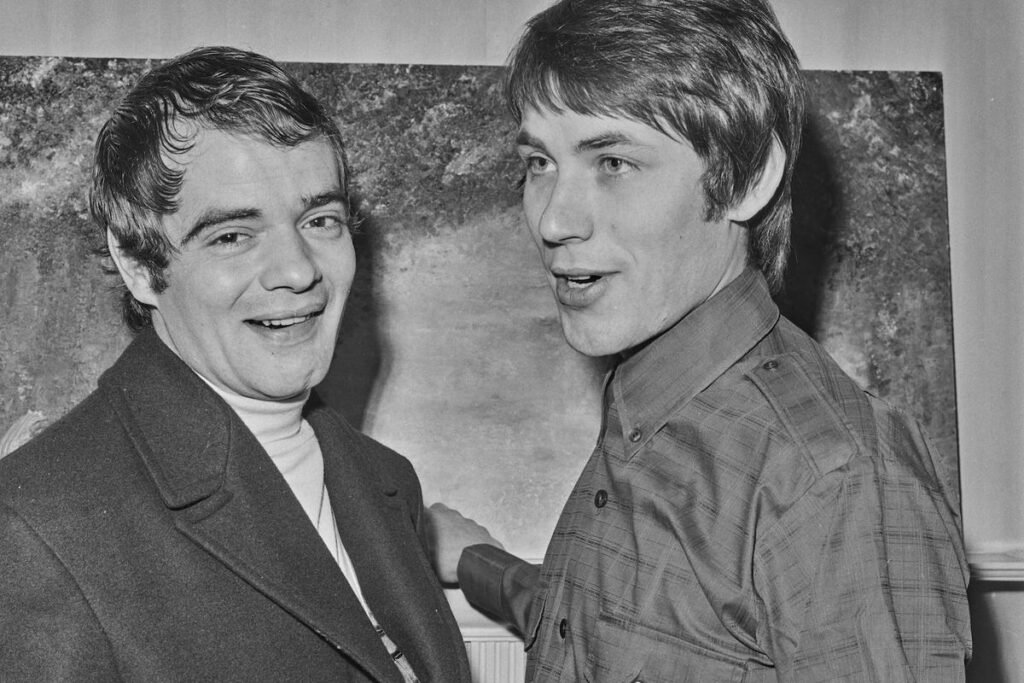
When the Who was first coming up in London in the early ’60s, they were not using their own songs — their set lists consisted of covers since Pete Townshend, who would go on to write hundreds of original Who songs, just wasn’t there yet.
But then he and his bandmates met Kit Lambert and his partner in filmmaking Chris Stamp. In the summer of 1964, Lambert and Stamp were seeking an unsigned rock ‘n’ roll band to feature in a documentary, and once they saw the Who — then performing under the name the High Numbers — they knew they’d found their subject. A promotional film was made and released that August, but it was Lambert’s encouragement of Townshend to write his own material that made the most difference. Lambert, a former art school student like Townshend, saw his potential.
«I got guidance when I was really young,» Townshend later recalled to Rolling Stone in 2025. «I was 19 or 20 when I met Kit Lambert. He was exactly the right kind of guy to help me. He was gay. He didn’t treat me as a commodity. He appreciated my talent. He helped me as an editor, but he also helped me as an educator. He helped me learn about life and about society and the way that the industry works. He treated me with the most incredible respect. That wasn’t how the rock industry treated me.»
Lambert had gone to Oxford and was the son of a famous composer, Constant Lambert, the founding music director of the Royal Ballet. But his sophisticated background mattered little when it came to working with the Who.
«Kit was the only posh guy I’d ever spoken to who was actually interested in me and wasn’t talking down to me,» Roger Daltrey recalled in a 2015 documentary titled Lambert & Stamp (via The Oregonian). «Their ideas were fantastic — and that’s all I cared about.»
Many of those ideas eventually became the most famous things about the Who’s career. Lambert and Stamp encouraged their on stage destruction of instruments (mostly by Townshend and drummer Keith Moon) as a sort of rock theater, nudged Townshend in the direction of writing what would later be described as «rock opera» music and suggested to Daltrey that he stutter the lyric to «My Generation» in the style of a skittish teenager. Perhaps most importantly, Lambert proposed the band change their name back to the Who.
«Kit often used to fantasize about doing things on a grand scale,» Townshend told Who biographer Dave Marsh at one point. «It was him pushing us to do things in a grander way…[he] was telling me I was a great writer. And I believed him because I wanted to believe him.»
The End of Kit Lambert and the Who’s Working Relationship
In 1967, Lambert and Stamp established their own label, Track Records, one of the very first British-owned independent record labels in the U.K. Of course, it hosted the Who, but also acts like the Jimi Hendrix Experience, the Crazy World of Arthur Brown, Thunderclap Newman and Golden Earring, among others. Promising as things seemed, financial mismanagement came into play, leading to the label’s end in 1978.
In addition to the fiscal issues, Lambert and Stamp fell toward the more unsavory side of rock ‘n’ roll.
«Kit taught Keith about wine, about fancy restaurants,» Stamp told Tony Fletcher for the Moon biography Dear Boy. «But Keith turned Kit on to pills. They always had an incredible strange affinity.»
Listen to the Who’s ‘My Generation’
Lambert developed a heroin habit, unwelcome at any time but particularly in a period where the Who needed guidance as they forged ahead with their music. Townshend was then working on Lifehouse, the follow up to Tommy, which would actually become Who’s Next. Studio sessions for these songs became more and more tumultuous, prompting the Who to hire Glyn Johns of Beatles and Rolling Stones fame as an associate producer. And there was also the matter of missing money, a situation that was made even more concerning when the Who learned that Lambert was shopping a film version of Tommy without their consent.
Townshend attempted reconciliation by asking Lambert to help him with 1973’s Quadrophenia, but by then it was clear that Lambert was not fit to be working with the band. He and Stamp were both fired in 1974 and replaced by Bill Curbishley, who still manages the Who today. Three years later, the Who’s lawsuit against Lambert and Stamp over unpaid royalties and other copyright issues was finally settled, and Townshend received a $1 million settlement.
Kit Lambert’s Death
From there, Lambert worked with a handful of early punk bands, though not much came of it. In 1980, he began work on an autobiography with journalist Jon Lindsay, though an official publishing deal was never signed.
On April 7, 1981, Lambert was seen at the El Sombrero in London, drinking heavily. The exact truth remains unclear, but a number of people over the years, including Townshend, have said that Lambert was beaten up that night by a drug dealer over some unpaid debts, which in turn led to a terrible accident: Lambert fell down a flight of stairs and subsequently died of a intracerebral hemorrhage. He was 45 years old.
«He was already in advanced stages of whatever,» producer Tony Vicsonti wrote in his autobiography Bowie, Bolan and the Brooklyn Guy. «He died when a coke dealer pushed him downstairs.»
READ MORE: The Who Album Opening Songs Ranked
Despite their disagreements, in Lambert the Who had found someone willing not only to take a chance on their talent, but to fully support a band that was trying things that had never been tried before.
«Kit was the only one who could really communicate to Pete what was good and what was bad, and Pete would accept it,» Daltrey explained in the Classic Albums documentary about the making of Who’s Next (via Guitar Player). «He wouldn’t accept anything otherwise.»
«There was a sense that everything about the band was being honored in the studio,» Townshend said in Lambert & Stamp (via Rolling Stone). «If I had written three songs and presented them to him, they were all good. He wouldn’t say ‘They’re all good, but that one’s great.’ It would be ‘They’re all good, and let’s work on that one.’ What I started to realize over a period of many years was that the one he picked to work on was the one he thought was either promising or great.»
Lambert was cremated and laid to rest in the family plot in Brompton Cemetery in London. In 2018, his gravestone’s inscription, which had severely deteriorated, was updated: «Also Constant’s son, Kit Lambert, 1935–1981, the man who made the Who.»
The Who Albums Ranked
Half of the Who’s studio albums are all classics, essential records from rock’s golden age. But where should you start?
Gallery Credit: Michael Gallucci




Comentarios