


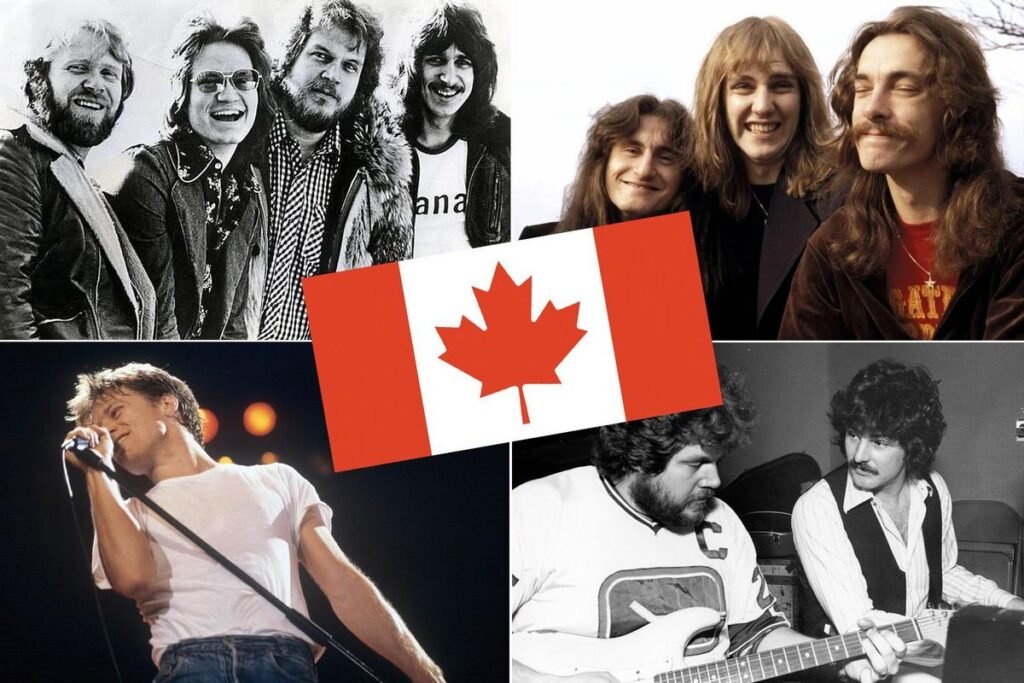
Scott Joplin may have given us the «Maple Leaf Rag» 127 years ago, but a legion of Canadian musicians have made sure we know the Maple Leaf nation rocks, too.
The Great White North has long enjoyed something of a best-of-all-worlds situation. As part of the British Commonwealth it’s been privy to acts from across the pond, often getting exposure before they’re exported to the the United States.
Meanwhile, the music from south of the border made its own way up, particularly via the northern border towns — and, interestingly, Windsor, Ontario’s CKLW-AM wound up breaking more than a few American acts it was able to give its limited non-native slots to.
Nevertheless Canadian Content laws, although modified over the years, gave indigenous talent a leg up on the country’s radio stations, and supportive governmental programs insured enlightened support on the federal, provincial and local levels.
All of that created a thriving music community for aspiring Canuck rockers, from the time Toronto’s The Four Lads started scoring doo-wop hits during the 50s, and when Ronnie Hawkins moved from Arkansas and formed his band the Hawks with future members of The Band.
Canadian rockers didn’t start getting over in the States until the Guess Who dropped «These Eyes» in 1969, but the scene has always done quite well on its own and even birthed the likes of Neil Young, Joni Mitchell and Steppenwolf, as well as the Band, who found their success after going expatriate in its southern neighbor.
And for every Triumph, Nickleback or Barenaked Ladies, there’s a legion of others — April Wine, Coney Hatch, Moxy, Trooper, Chilliwack, Kim Mitchell, Max Webster, the Tragically Hip, Our Lady Peace the Sam Roberts Band and many more — whose fame was limited to the provinces.
In determining this Big 4 we have determined to keep our consideration to those who stayed home to launch and maintain most, of not all, of their careers — and certainly the key breakout and successful eras. Even then the candidates were prolific, and difficult to choose from. But after much chin-scratching and tippling a Caesar or two, we flipped a looney and decided on these as the Big Four tentpoles of Canadian classic rock…
The Guess Who
Michael Ochs Archives, Getty Images
The Guess Who wound its way into being, starting in 1962, as Chad Allan & the Reflections (with Randy Bachman on guitar, Jim Kale on bass and Garry Peterson on drums), the morphing the following year into Chad Allan & the Expressions and hitting No. 1 in the Great White North with Johnny Kidd & the Pirates’ «Shakin’ All Over.»
After its Canadian label credited the song to the Guess Who?, Allan and company adopted the name in 1965, with Burton Cummings joining as singer and keyboardist in 1966.
They dropped the question mark and Allan dropped out to return to college, and the remaining quartet released its first album, It’s Time that summer. It was a 1967 gig as the house band for the CBC Radio program The Swingers and the subsequent CBC television program Let’s Go — playing renditions of other artists’ hit singles and, eventually, their own songs — that gave the band national standing and got the attention of record producer Jack Richardson.
«These Eyes» from 1969’s Wheatfield Soul went Top 10 in the U.S. as well as Canada, launching a string of hits that included «Laughing,» «Undun,» «No Time,» «American Woman» and «No Sugar Tonight.» Bachman left during 1970, subsequently forming Bachman-Turner Overdrive, while Cummings led the band for another five years, keeping it on the charts with «Share the Land,» «Hang on to Your Life» and «Clap For the Wolfman,» among others.
A murky chapter of the Guess Who’s history began with a 1999 reunion, during which Kale trademarked the unprotected band name — much to Bachman’s and Cummings’ chagrin — eventually cutting Peterson in and operating a band that at times had no original members playing on stage.
Bachman and Peterson declared war on what they called «the fake Guess Who» in 2013 with a $20 million lawsuit; Cummings dropped the big bomb during April of 2024, removing his music from blanket licensing that allowed anyone to perform his songs.
This essentially neutered the Kale-Peterson group, which settled out of court and gave Bachman and Cummings rights to the Guess Who name. Their edition of the band returned to the state during January in Niagara Falls and will be touring North America throughout the spring and summer.
Bachman-Turner Overdrive
Hulton Archive, Getty Images
While the Guess Who was waning, Randy Bachman was, well, takin’ care of business. After his ouster the guitarist went back Chad Allan to form a new band, the country-leaning Brave Belt, with Bachman’s younger brother Robbie on drums.
Singer-bassist C.F. «Fred» Turner joined on base for Brave Belt II with another Bachman, Tim, playing guitar on tour; when Allan went his own way again, the four decided to form their own band, and after a number of turn-downs signed a deal with Mercury Records and adopted a new name based on the trucker magazine Overdrive.
BTO, as it was known, wasn’t with us for a long time — a six-year, six-album run with the classic lineup (Blair Thornton replaced Tim Bachman in 1974) — but it definitely had a good time. Its first five albums were Top 10 in Canada, and Bachman Turner Overdrive crossed the border even more forcefully than the Guess Who with a parade of hits such as «Takin’ Care of Business,» «Let It Ride,» «You Ain’t Seen Nothing Yet,» «Roll on Down the Highway» and «Hey You.»
At that point in time it personified Canadian rock with a beefy, guitar-driven attack that was deceptively straightforward but deserved more credit for sophistication than the band received. Turner’s soulful growl and Bachman’s reedy tenor perfectly complemented each other, and BTO established a template that even a successor like Nickelback would mine later on.
There have been a variety of reunions with assorted personnel over the years, including at BTO’s Canadian Music Hall of Fame Induction in 2014. Though Robbie and Tim Bachman have passed away the band is still technically together as of 2023, though Turner appears as an occasional guest.
At the moment, however, it’s been subsumed by Randy Bachman’s and Burton Cummings’ reactivated Guess Who, whose shows include a few of the BTO hits as well.
Rush
Fin Costello, Getty Images
Canadian rockers succeeding in the U.S. was still a novelty when this trio of «Working Man» men flew — by night and otherwise — out of Toronto. Straddling the defined lines between hard rock, heavy metal and prog, Geddy Lee, Alex Lifeson and, initially John Rutsey formed Rush during 1968 and released their debut album in 1974.
It wasn’t a major success but did find pockets of embrace on both sides of the border, especially from WMMS-FM in Cleveland. That attention helped Rush get a booking agent and a deal with the major label Mercury Records; the more accomplished Neil Peart replaced Rutsey on drums in 1974 and brought his more advanced lyricism with him.
The support put wind beneath the wings of the sophomore Fly By Night album, and Rush’s work ethic — non-stop touring and five album releases in the course of four years — steered the group in an upward trajectory.
Its legacy is iconic: 19 studio albums (10 of them platinum); incendiary and virtuosic live performances; and a wealth of memorable songs ranging from side-long epics such as «2112» to radio favorites like «Fly By Night,» «Closer to the Heart,» «Limelight,» «The Spirit of Radio» and, of course, «Tom Sawyer.»
The trio’s wonderful sense of humor was evident from the time Lee joined Bob and Doug McKenzie (Rick Moranis and Dave Thomas) for «Take Off» in 1981 and became pronounced features of its stages (the rotisserie ovens, the washing machines, the animated videos).
Rush was thought to have ended after its 40th anniversary tour in 2015 and Peart’s death in 2020 from brain cancer. Fans kept the Rush flag flying, of course, and after some brief but high-profile reunions Lee and Lifeson announced Fifty Something reunion tour that begins June 7 in Inglewood, Calif., with Anika Nilles on drums and a first-ever fourth member, Loren Gold (the Who, Chicago, Kenny Loggins, Don Felder) on keyboards. And nobody’s ruling out the possibility of some new music, either.
Bryan Adams
Fryderyk Gabowicz, Getty Images
Leather-jacketed, lean and capable of writing songs that make the young girls cry and the dudes rawk!, Bryan Adams is an everyman turned auter.
Born in Kingston, Ontario, Adams has sold more than 65 million albums worldwide (1984’s Reckless accounts for more than 12 million of them), and his hit parade since 1978’s «Let Met Take You Dancing» includes 17 Top 10s on the Billboard Hot 100.
Among those are «Run to You,» «Heaven,» «Summer of ’69,» «Somebody,» a duet with Tina Turner («It’s Only Love») and chart-topping, record-setting movie songs such as «(Everything I Do) I Do It For You,» «Have You Ever Really Loved a Woman?» and «All For Love» with Rod Stewart and Sting.
He and longtime songwriting partner Jim Vallance also composed songs for Pretty Woman: The Musical on Broadway. Adams’ honor roll includes three Academy Award and five Golden Globe nominations, stars on the Hollywood and Canada’s Walks of Fame, inductions into the Canadian Music and Canadian Broadcast Halls of Fame, and Order of British Columbia and Order of Canada awards for his music and philanthropic work.
On top of all that Adams is a globally recognized fashion and artistic photographer whose work has been published in magazines and exhibited in museums worldwide. He was among a select corps of photographers invited to photograph Queen Elizabeth II during her Golden Jubilee in 2002; one of his shots was subsequently used as a Canadian postage stamp.
Adams has never stopped that thing he started; now managing himself and operating his own label, Bad Records, he released Roll with the Punches in 2025 and is currently touring in South America, with Canadian and European treks ahead.

Comentarios